The Gym Girl’s Guide to Training Through Low Motivation

The Gym Girl’s Guide to Training Through Low Motivation
After years of coaching women through different training phases, busy seasons and everything else life likes to throw at us, I’ve noticed some really clear patterns around motivation.
When someone first starts a new training program, motivation can feel almost effortless. There are new exercises to try, new goals to chase and maybe even a few new gym outfits waiting for their moment.
Everything feels fresh, and they’re excited to see what happens.
But eventually, the novelty wears off.
This is the point I see so many women struggle with, bc now they’ve reached that slightly less glamorous stage where they’re putting in the work and can’t quite see the results of it yet.
They’re no longer running on the excitement of starting, but they also haven’t reached the point where all those small efforts have added up to an obvious change.
They’re just… in the trenches.
And when that happens to line up with a busy month, poor sleep, work stress or a lot going on mentally and emotionally, getting to the gym can suddenly feel much harder than it normally does.
This article is based on the patterns I’ve seen repeatedly in my own coaching, along with the things my Power Curve clients have told me genuinely help them stay on track. Because motivation will naturally rise and fall, so here are some of the strategies that help myclients keep training through those lower-motivation periods.
1. Give yourself something specific to work towards
One thing clients regularly tell me is that the training blocks help them stay motivated because there’s always a clear focus and something specific to work towards.
This is where periodisation comes in. Instead of trying to improve your strength, build everyyyy muscle, increase your fitness, push maximum training volume AND stay lean all at once, you divide your training year into smaller blocks, or mesocycles, with a more specific purpose.
Here’s what Shravani said, she’s a member of my hourglass app Power Curve
One block might place more emphasis on strength. Another might focus on more volume for your glutes and hamstrings. You may have a phase with more unilateral work, a higher-volume block, or a period dedicated to refining technique and building stability.
Having a clear focus makes training feel more purposeful! You know why each exercise is there, what you’re trying to improve and what progress actually looks like during that phase.
It also gives you shorter finish lines.
“Train consistently forever” feels incrediblyyyy vague.

“Complete this block and improve these three lifts over the next 9 weeks” gives your brain something MUCH more tangible to grab onto.
Well-planned blocks also allow changes in volume and intensity across the year, rather than asking your body to push at full capacity indefinitely. That helps you manage fatigue and recovery while continuing to make progress over time.
2. Check whether you’re actually under-recovered
Another thing my Power Curve clients find really helpful is the built-in recovery calculator.
It gives them a way to look at what’s happening across their training, sleep, stress and general life load before automatically deciding that they just need to “grind through.”
Because SOMETIMES what looks like low motivation is actually under-recovery.
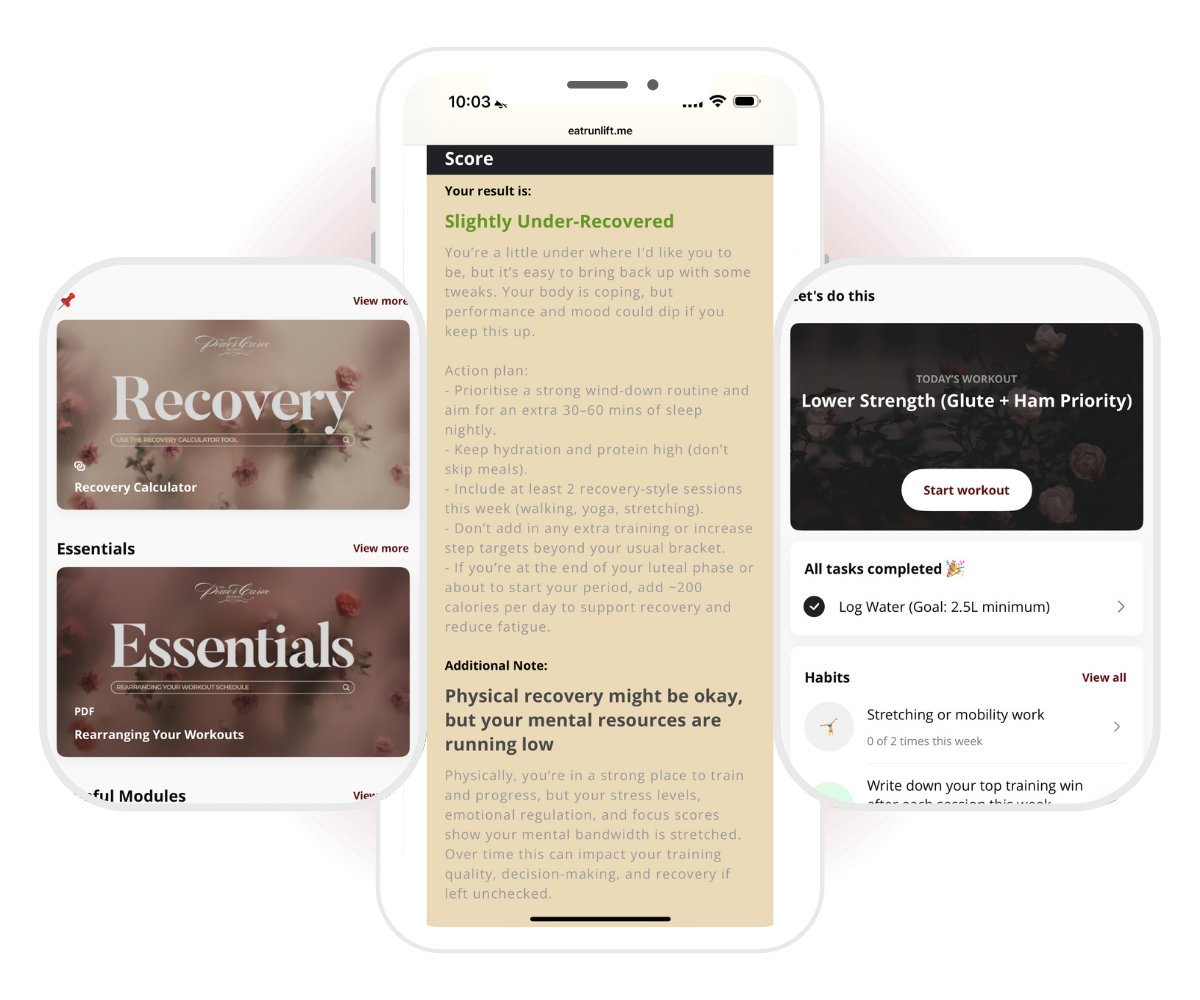
If you’re someone who naturally keeps yourself busy and normally has no major issue getting to the gym, I dare say you haven’t suddenly become lazy overnight. A noticeable drop in motivation, especially when it comes with poor performance, lingering soreness, irritability, disrupted sleep or feeling unusually heavy and flat, CAN be a sign that your overall recovery needs attention!
Look at the full picture.
Have you eaten enough?
Have you been sleeping properly?
Has your non-gym activity increased?
Are you carrying more emotional or mental stress than usual?
Have you been training hard for a few months without a deload or recovery period?
Learning to tell the difference between “I don’t feel like starting” and “my body genuinely needs recovery” is one of the most useful skills you can build :) !
Mar in my Power Curve program said this:
3. Reduce friction by making fewer decisions
Every additional decision creates another opportunity to talk yourself out of training.
What workout should I do? What time should I go? What should I wear? Should I train upper or lower? Which exercises are best? Is this program even working? Maybe I should find a different one first………..

Suddenly, you’ve spent 45 minutes researching the “perfect” workout and zero minutes actually doing one.
Following a structured program removes most of this friction.
You open your program, see exactly what session is scheduled and start. You don’t need to reinvent your training every time you walk into the gym.
You can reduce even more friction by:
packing your gym bag the night before,
keeping your headphones charged,
saving a simple pre-training meal you know sits well, and
laying out your clothes in advance.
TBH none of these things are groundbreaking on their own, but together they make starting require far less mental energy.
Low-motivation weeks are NOT the time to create more choices.
4. Book your training into your schedule
If your training only happens when you “find time,” it will usually be pushed aside by anything that feels more urgent.
At the start of each week, look at what you actually have going on and book your sessions into your schedule.
Choose the days and times that are realistic, nottttttt the ones that belong to an imaginary version of you who has endless energy and no unexpected interruptions hehe
This also gives you a chance to plan around your hardest days.
If Thursday is stacked with meetings and you’re usually mentally cooked by the evening, that probably isn’t the best place for your most demanding lower-body session. Put that workout somewhere you have a little more breathing room, and use Thursday for rest or a shorter session.
5. Commit to just five or ten minutes
When a whole workout feels overwhelming, make the entry point smaller.
Tell yourself you only need to exercise for five or ten minutes.
Do your movement prep,
complete the first exercise and then check in with yourself.
If you still genuinely want to stop, you’re allowed to stop, but usually, you’re fine once you’ve started.
Once you’ve changed, arrived at the gym and begun moving, momentum takes over and continuing feels much easier than it did from the couch.
But the permission to stop matters.
This isn’t a sneaky way to gaslight yourself into a full workout every time. Some days, those ten minutes will confirm that you’re exhausted and need to go home.
Either way, you’re learning to start and just lean into the habit of getting there.
6. Make sure your program has room to flex
A good training program should give you structure, but it shouldn’t be so rigid that one disrupted day makes you feel like you’ve messed up the entire week.
Make sure you understand how to adjust your program when your recovery or circumstances change.
That might mean knowing how to deload when fatigue is building,
reducing the number of sets you complete,
using a lighter load or moving a demanding session to another day.
And if you genuinely don’t have the capacity for a full weights session that day, swap it for something that better matches the energy and time you DO have.
e.g. Pilates, a mobility flow, a shorter session or simply going for a walk.
This doesn’t mean replacing every challenging workout the second you don’t feel wildly enthusiastic about it heheh.
But I do want you to be adaptable enough to choose an appropriate version of movement instead of falling into black-and-white thinking about what “counts.”
Because it’s not a light switch, the choice usually isn’t limited to completing the entire session exactly as written or doing absolutely nothing. There is a wholeeeee dimmer between those two options.
7. Give yourself something to enjoy
Your training can be effective and still feel enjoyable. In fact, you’re far more likely to continue doing something when there are parts of the experience you genuinely look forward to.
Make a playlist that you only listen to while training (this is my entire ‘liked’ list on Spotify tbh)
Save a favourite podcast for your walk to the gym.
Wear the outfit that makes you feel good.
Train with a friend.
Go to the gym with the lighting, atmosphere or equipment you prefer when you have that option.
These details don’t replace a well-designed program, but they can make the entire routine feel more inviting,especially during weeks when the long-term result feels very far away.
8. Know the deeper reason you’re doing this
There’s nothing wrong with wanting abs, bigger glutes or a particular physique. Aesthetic goals are completely valid. But when training gets hard, “I want abs” may not always feel meaningful enough to get YOU moving.
Your deeper reasons tend to need more emotional weight.
Maybe it’s something like you want to be strong enough to carry your child, partner or pet out of danger if there were ever an accident.
Maybe you want to remain independent as you age
Maybe you know training regularly helps tame the brain gremlin that is neurodivergence (one of the biggest motivators for me!)
Maybeee training gives you time that belongs entirely to you
Maybe you want to travel, hike, play sport or move through everyday life without feeling physically limited.
Ask yourself what being strong and capable would actually allow you to do.
Then keep that answer somewhere you can return to when the surface-level motivation has gone missing.
Your “why” doesn’t need to sound impressive to anyone else btw, it just needs to mean something to you.
Motivation won’t always be there
The goal is to know yourself well enough to understand what you need when motivation drops.
Consistency is really about having enough self-awareness and flexibility to keep moving forward without abandoning the whole process every time your energy changes.
Motivation might help you begin, but knowing yourself is what helps you continue.
And if you’d like my help, Power Curve is waiting for you!
We begin a new live training block every few months, so there’s always a fresh focus to work towards without constantly jumping between random programs.
Our next live block begins on September 14.
Want to see what it’s all about?
Hey there, I’m Rachel!
NUTRITIONIST, PERSONAL TRAINER, WELLNESS COACH
If you’re ready to ditch the all-or-nothing mindset and build a strong, confident body—you're in the right place.
✨ Start with my free 5-day Mini Mindset Reset to design a healthy lifestyle that actually fits your life.
🍑 Or join The Power Curve Method, my signature hourglass training program built to shape your glutes, waist, and mindset from the inside out.
While we make every effort to make sure the information in this website is accurate and informative, the information does not take the place of medical advice.