Training for an Hourglass Shape? Fix These Before You Add Another Glute Exercise
When most women decide they want to build more of an hourglass shape, the first thing they do is add more stuff to their routines.
Like adding some additional glute exercises. Or adding more ab work for the waist.
Or throwing in a “this one secret exercise grew my shelf booty in 14 days” from an IG reel they found.
And listen, I get it.
It is soooo easy to think the answer is hiding in one fancy movement you have not tried yet.
But sometimes the issue is not that you need more in your weight training.
Sometimes you need to take a tiny step backwards and look at how you are actually holding yourself, inside the gym and out!
Because if every hip thrust turns into a lower-back exercise, every cable kickback turns into your spine acting like a wet noodle, and every split squat your feet collapsing inward and shaking… adding more volume is probably not the first thing we need to do tbh :)
FIRST, let’s look at your rib position, your pelvis, your ability to control your trunk, and whether you can actually keep tension where you are trying to build muscle.
When you are training for an hourglass shape, your foundation matters.
Because yes, growing your glutes, legs, upper back, shoulders and rear delts will absolutely change your shape over time, no question about it.
BUT if you cannot control your torso and pelvis while you train, you may find it MUCH harder to feel your glutes properly, stay stable in lower-body work, and stop your lower back from trying to hijack every set and steal those glute and leg gains.
First: no, you do not need to “fix your posture”
Before we get into rib flare and anterior pelvic tilt, we need to clear something up because the posture content online can get a bit crazyyyy.
You do not need “perfect posture”.
You do not need to have completely flat ribs.
You do not need to stand with your pelvis in one exact position all day.
You do not need to “correct” every tiny curve in your body.
Bodies are supposed to move!!!!
Your ribs move when you breathe.
Your pelvis moves when you walk, squat, hinge, run, sit down and stand up.
A little arch in your lower back is not automatically bad.
A pelvis that tips forwards slightly is not automatically a dysfunction.
Ribs that look a bit more prominent are NOT proof that your deep core is weak.
The issue is whether you can access useful positions when you are lifting…
Can you do a hip thrust without overextending your hips at the top?
Can you do an RDL without lifting your chest, flaring your ribs, toes coming off the ground and losing all the tension in your hamstrings?
Can you do a split squat without your torso wobbling around, your pelvis twisting, and your front foot collapsing inwards by rep eight?
That is what I care about… Better control.
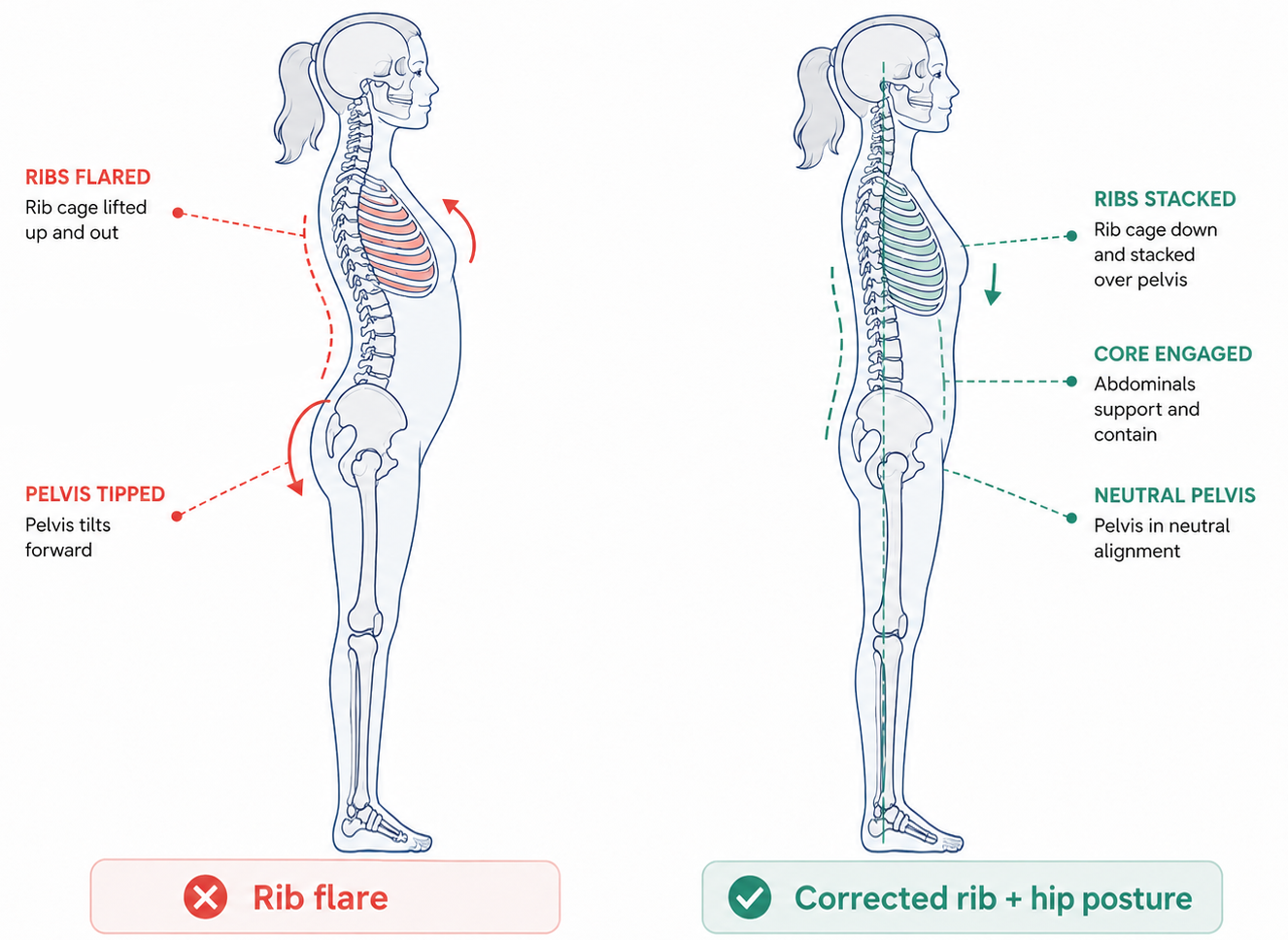
What people ~actually mean when they say “rib flare”
“Rib flare” is usually used to describe a position where the lower part of your rib cage looks like it sits forward or lifts upwards.
Like my client Kelsey was dealing with 3 months ago (the pic on the right is how they sit now btw)

You might hear people say things like:
“Your ribs are flared because your core is weak.”
“Your diaphragm is dysfunctional.”
“You need to pull your ribs down all day.”
Those are VERY simplified versions of something that is actually a bit more nuanced.
Your ribs are connected to your spine. They move with your breath, and they are influenced by the way you stand, the way you brace, how much you lift your chest, and how much you extend through your upper and lower back.
So if you stand there with your chest up, shoulders pulled wayyyy back, lower back arched and stomach sucked in, your ribs may look more prominent

If you breathe out, soften your chest slightly and bring your torso into a more controlled position, your ribs may look less prominent.
That does not mean you have “fixed” your rib flare forever.
It means you changed your rib position.
And that is actually good news btw,, because it means you may be able to learn more control over your trunk rather than thinking you are stuck with some permanent body issue.
What is anterior pelvic tilt?
Anterior pelvic tilt is just a fancy way of saying your pelvis tips forwards.
When that happens, the front of your pelvis sits lower than the back, and your lower back often looks more arched.
Sometimes your bum may look more projected.
Sometimes your stomach may sit differently (think ‘stomach pooch’ - the area under the belly button, can stick out a bit more).
But again: this is NOT automatically bad.
SOME anterior pelvic tilt is completely normal. Your pelvis is meant to move forwards and backwards. It is meant to rotate when you walk. It is meant to move when you squat, hinge, lunge and climb stairs etc~
The problem is not “having” anterior pelvic tilt.
The problem is when your body only has one strategy to approach movements.
For example, if every time you try to extend your hips in a glute bridge, you go straight into a huge lower-back arch, then you may need to work on controlling your pelvis and ribs at the top of the movement.
If every time you do an RDL, your hips stop moving but your lower back keeps going, then we may need to teach you how to hinge from the hips without stealing range from your spine.
That is not about forcing yourself into a permanent pelvic tuck hahaha, but rather just making sure your body knows it’s options.
Why so many women struggle with this
A LOT of women grew up being taught to suck their stomach in.
Especially if you grew up in the 90s or early 2000s, there was this weird cultural obsession with having a completely flat stomach at all times. Like heaven forbid your abdomen exists after eating lunch.
So many of us learned to stand with our stomach pulled in, chest lifted, ribs pushed forward and lower back arched.
And then we wonder why, when it is time to brace in a squat or a hip thrust, our body has absolutely no idea what we are asking it to do.
You may be trying to “brace” by gripping your stomach as hard as possible.
OR you may be:
holding your breath
lifting your chest and flaring your ribs more
trying to tuck your pelvis so hard that your glutes switch off completely
just feeling confused bc every trainer online is throwing different cues at you.
And this can be especially relevant for neurodivergent women or women with hypermobility… because when you are tired, overstimulated, distracted, hyperfocused, disconnected from your body, or naturally more flexible through certain joints, it can be easier to default into whatever position feels easiest in the moment.
How do you know whether this is affecting your training?
You do not need to stare at yourself side-on in the mirror and try to diagnose your entire body, please don’t haha.
Instead, try to feel what happens in your exercises.
Any of these familiar?
You feel hip thrusts mostly in your lower back instead of your glutes.
You get to the top of a glute bridge and your bottom ribs move up towards the ceiling.
Your lower back feels like it takes over the second a set gets hard in RDLs.
You cannot tell whether you are moving from your hips or from your spine in a leg press or squat.
You lose your balance often in split squats, lunges or single-leg RDLs.
Your ribs flare out or stomach domes out every time you press, row, deadlift or perform core work.
You hold your breath and clench your stomach through the entire set.
You feel like your form looks completely different when you are fatigued.
You can “feel” your glutes in warm-ups, but lose them as soon as the weight gets challenging.
What can you actually do about it?
Good news: you do not need to spend 45 minutes a day doing posture drills on the floor.
My approach is
You need a few strategic exercises that help you feel your ribs, pelvis and deep core working together, this will cultivate the mind-body awareness and connection
THEN you need to take that awareness into your main lifts.
That is it.
1. Learn to exhale without sucking your stomach in
A useful place to start is learning how to breathe out properly without gripping your abs, rounding your upper back, or trying to force your pelvis into an aggressive tuck.
Try this 360 Breathing tutorial from inside the Power Curve Method:
2. Learn to control your pelvis in both directions
You do not need to permanently tuck your pelvis under and force it to stay there :p
You just need to be able to move it on purpose when needed.
I have moves for this built into Power Curve too!
3. Build deep-core strength through actual movement
Deep-core training does not mean doing 500 crunches and trying to grow those 6-pack abs.
It is essential to learn how keep your trunk controlled while you breathe, move your limbs and eventually add load.
The goal is to build a core that can transfer force between your upper and lower body :)
Because when your trunk is more stable, it is usually easier for your glutes and legs to do THEIR job instead of your lower back having to do everybody else’s.
Try this deadbug variation on a foam roller:
4. Start with exercises where you can actually feel the difference
When you are trying to learn a new movement strategy, do not start with your heaviest hip thrust, your heaviest RDL or your hardest split squat variation.
Pleaseeee.
Use a lighter version first!!!
A bodyweight glute bridge.
A light cable kickback.
A supported split squat.
A light RDL with a slow tempo.
Give yourself enough space to notice what is happening.
Can you feel your glutes doing the work?
Can you keep your ribs and pelvis more controlled?
Can you breathe while your core is switched ‘on’?
Can you stop your lower back from trying to grab every rep?
Once the position feels more consistent, THEN we progressively load it.
Because this is still hypertrophy training, so we are not trying to avoid hard work, but rather we are just making sure the work is going into the right place.
So remember this…
When your trunk and pelvis are all over the place during training, it can be harder to get the most out of those hard sets. And you’re putting in all that hard work for.. what??
You might keep adding exercises because you think the programme is the issue, when actually the bigger issue is that you are not able to execute the exercises you already have consistently.
Join the July 6 Power Curve Block
The new training block starts on July 6, and this is your little heads-up that the price will be increasing soon.
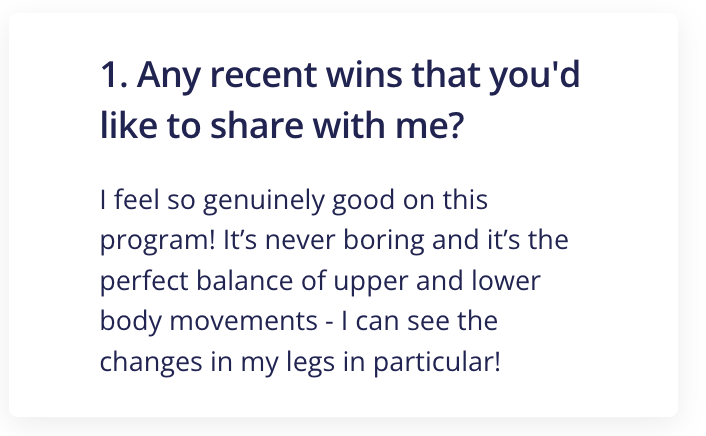
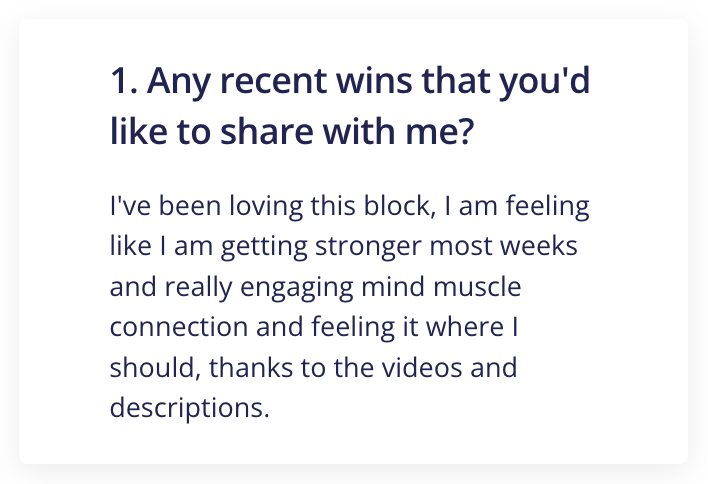
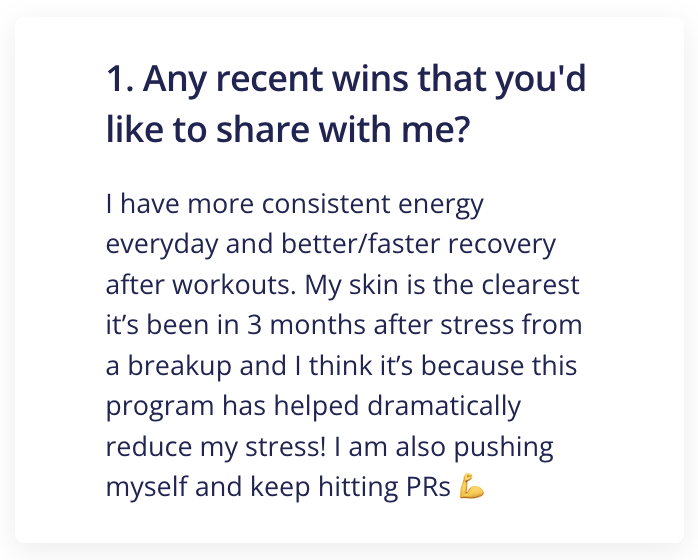
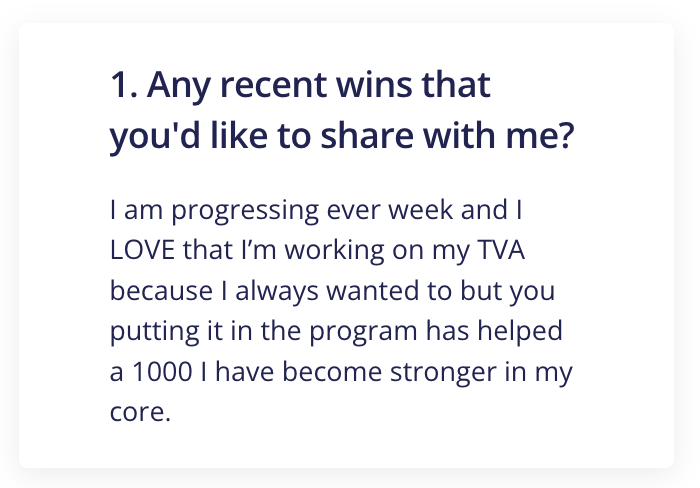
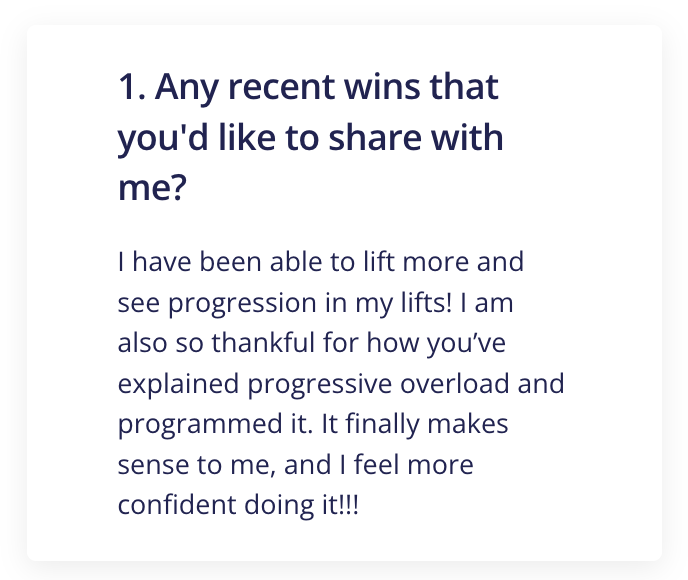
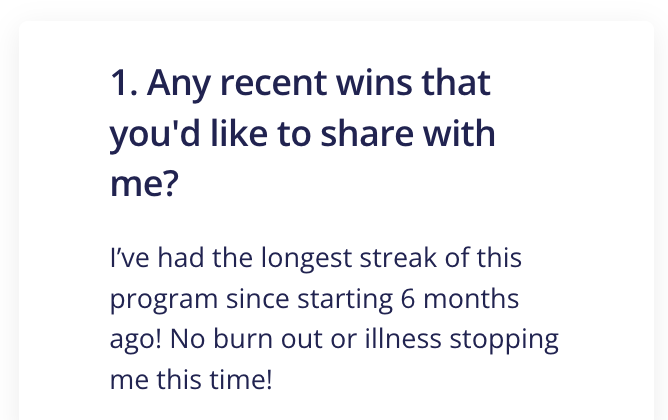
I have added soooo much more into this programme than it originally included when we first launched, and here’s what the PCM members are saying:
This is NOT a “download a workout PDF and good luck babe xo” kind of thing, I’m too much of a control freak for that hahaha.
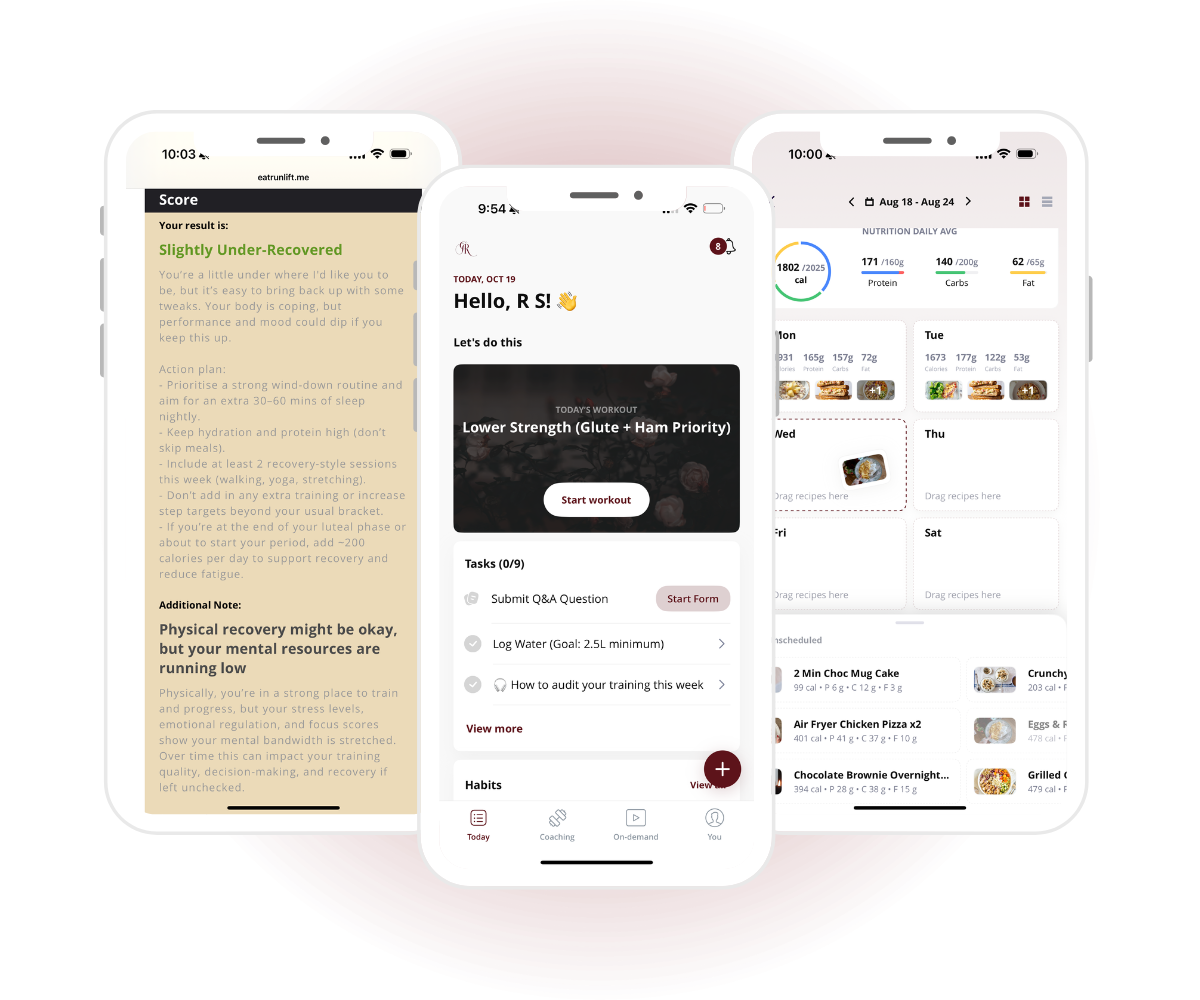
You have structured training, deep-core and posture-aware work, nutrition tools, exercise tutorials, huge recipe library, Q&As with me, on demand recovery sessions, and more tools inside the app to help you stay consistent without needing to overthink every single session.
So if you join the July 6 block before the price increase, you can lock in the current lower price for the entirety of your membership !!! How fab!
Hey there, I’m Rachel!
NUTRITIONIST, PERSONAL TRAINER, WELLNESS COACH
If you’re ready to ditch the all-or-nothing mindset and build a strong, confident body—you're in the right place.
✨ Start with my free 5-day Mini Mindset Reset to design a healthy lifestyle that actually fits your life.
🍑 Or join The Power Curve Method, my signature hourglass training program built to shape your glutes, waist, and mindset from the inside out.
While we make every effort to make sure the information in this website is accurate and informative, the information does not take the place of medical advice.