The Beginner’s Guide to Building Curves Without Falling for Fitness Internet Nonsense
The Beginner’s Guide to Building Curves Without Falling for Fitness Internet Nonsense
I have a platform online, so I KNOW this post might sound a little ironic hahaha.
BUT I have also been in the nutrition and fitness space for 11 years. I have watched trends come and go, watched certain exercises get declared “the secret” to a good body every six months, and watched people become convinced that the answer to their goals is always one more complicated rule, supplement, workout or food swap away.
As someone qualified in both nutrition and personal training, it genuinely frustrates me how much rubbish people now have to sift through before they can find useful advice.
Because the problem is not that there is no information available. The problem is that there is too much information, and a lot of it has been designed to get attention rather than get you results.
Online, novelty wins.
The shocking claim wins.
The weird-looking exercise wins.
And once something gets enough exposure, people start trying it, sharing it and treating it like fact before anyone has stopped to ask whether it is actually useful.
So, let’s clear up a few things !!!
If your goal is to build a more exaggerated hourglass physique, get stronger, improve your body composition and stop feeling like you need to reinvent your entire routine every week, these are the things I want you to keep in mind:
“Toning” is not a training method
“Toning” is one of those fitness words that has hung around for far too long because it sounds less intimidating than saying what people actually mean.
Most women who say they want to “tone up” do not mean they want a magical toned-muscle exercise plan. They usually mean they want more shape, more visible muscle definition, a firmer-looking physique, or to feel more confident in their clothes.
That look generally comes from two things:
Building enough muscle
Having an appropriate level of body fat for your body and goals
That is it 😃
There is no special “toning” rep range.
There is no magic 2 kg dumbbell routine that creates definition while somehow avoiding muscle growth.
And there is definitely no need to be frightened of lifting weights because you think you will accidentally wake up looking like a professional bodybuilder.
You need resistance training that is challenging enough to create an adaptation. That means learning good technique, using exercises you can progressively improve at, training close enough to your current capacity, and allowing enough time for the results to build.
The goal is to give your body a reason to change.
You do not need to feel your glutes ‘burning’ for a glute exercise to be working
e.g. You do a set of banded kickbacks, your glutes are on fire, and it feels like confirmation that something productive is happening.
But it is not the main thing we should be using to judge whether an exercise is effective.
A muscle can burn because it is working under fatigue. It can also burn because you have done 45 tiny pulses with a resistance band and created a lot of local discomfort without giving yourself much opportunity to actually progress.
Those are not the same thinggggg~~~
For long-term glute development, the bigger priorities are usually:
Stable, repeatable technique
A useful range of motion
Enough load for your current strength level
Sufficient effort
Progressive overload over time
A program that lets you recover and repeat that work consistently
You might feel your glutes strongly during a hip thrust, Bulgarian split squat, or cable kickback. Great.
But the aim is not to chase sensation at all costs.
The aim is to become measurably better at movements that train your glutes well, for instance, an RDL when performed well will feel more like a ‘stretch’ sensation rather than a burn or a strong contraction.
Endless cardio is not the fast track to a curvier physique
Cardio is NOT the enemy, that’s not what I’m saying haha.
It is good for your cardiovascular health, fitness, work capacity, stress management, and it can absolutely support fat loss when stacked sensibly.
But if your main goal is to create shape through your glutes, legs, back, shoulders and core, doing endless cardio while barely progressing your resistance training is not the shortcut you think it is.
I have seen so many women try to “get lean” by adding more and more treadmill work, running, spin classes or HIIT, steps, while under-fuelling themselves and wondering why they cannot build their lower body.
You cannot out-cardio a training plan that does not have enough progression.
You also cannot build a curvier physique while treating food as the enemy and recovery as optional.
Cardio and strength training can work brilliantly together!!! The point is not to avoid cardio. The point is to make sure it supports your main goal rather than sneakily taking over your entire routine and recovery capacity~
This is exactly why I created my signature hourglass-focused program
Power Curve starts its next training block, Eclipse, on 6 July.
It is for women who are tired of random workouts, gimmicky glute circuits and constantly wondering whether they are doing enough, too much, or the wrong thing entirely.
Eclipse is an hourglass-focused hypertrophy block designed to build strength and shape through your glutes, legs, back, rear delts, shoulders and deep core.
It’s live, and everything is built right into my app.
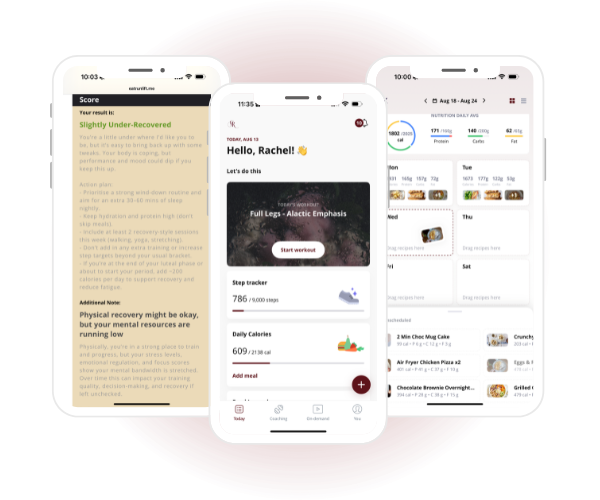
You will have three essential gym sessions each week, with an optional fourth session if you have the capacity and want more volume.
Inside Power Curve, you also get macro guidance, meal-planning tools, hundreds of macro-friendly recipes, form videos, a PB tracker, flexible cardio guidance, recovery tools and fortnightly Q&As with me.
It is built for someone who wants to train with purpose, get stronger, build shape and finally understand why they are doing what they are doing.
You can find out more and join here: https://thepowercurvemethod.com
Soreness is not proof that your workout ‘worked’
Being sore after training does not automatically mean your workout was amazing.
Soreness is often more likely when you introduce a new movement, increase your training volume, return after time away, use a longer range of motion, or train harder than your body is currently used to.
It also can be linked to shortened sleep, or poor recovery.
It is a response to novelty and stress.
In fact, chasing soreness can make training worse. You may keep changing exercises before you have had time to get stronger at them. You may add unnecessary volume because you think you need to “feel it”. You may train so hard that you cannot recover properly enough to progress the following week.
A better way to measure whether your training is working is to look at the boring stuff:
Are you improving your technique?
Are you adding reps, load or control over time?
Are you becoming stronger?
Are you training consistently?
Are you recovering well enough to keep showing up?
That is progress.
Not whether walking downstairs has become a full-body crisis.
You do not need to train six days a week to get results
Six-day training splits are NOT proof that someone is more committed. They are not automatically more advanced. And they are not necessary for most people trying to build muscle and change their physique.
Training frequency is a tool~
Some people love being in the gym five or six times per week. They have the recovery, the schedule and the genuine enjoyment to make that work. Great.
But plenty of people get excellent results from three or four well-structured sessions per week. I am one of those people 🙋
What matters more is whether your training has enough useful volume, enough effort, sensible exercise selection, progression and recovery.
For many women, a realistic three-day program they can actually complete consistently will outperform a six-day program they manage for two weeks before life gets busy, energy drops, and they disappear completely.
Many influencer ‘bookmark this workout’ workouts are content first and programming second
This one is probably the most important.
An exercise can look interesting, difficult, aesthetic or “advanced” on camera without being the best use of your training time.
Sometimes people choose exercises based on how they look to film, not because it makes a better program.
So this means you need to ask better questions before copying a workout:
What is this workout trying to achieve?
Does it fit with my goals?
Am I able to effectively progressively overload it?
The fitness industry has made people feel like training needs to be complicated to be effective.
When really, you just need a clear goal, a plan that matches it, the details to execute each component well, and enough consistency to let the plan work.
That is less exciting than a viral hack :) sorry, but it’s how I’ve been getting people amazing results for a decade!
Hey there, I’m Rachel!
NUTRITIONIST, PERSONAL TRAINER, WELLNESS COACH
If you’re ready to ditch the all-or-nothing mindset and build a strong, confident body—you're in the right place.
✨ Start with my free 5-day Mini Mindset Reset to design a healthy lifestyle that actually fits your life.
🍑 Or join The Power Curve Method, my signature hourglass training program built to shape your glutes, waist, and mindset from the inside out.
While we make every effort to make sure the information in this website is accurate and informative, the information does not take the place of medical advice.