The Science-Backed Way Busy Women Should Actually Train
The Science-Backed Way Busy Women Should Actually Train (and why doing more is often the thing holding you back)
For decades, women have been sold the idea that results come from doing more, more workouts, more cardio, more intensity, more discipline.
The reality is that for busy women, especially those juggling careers, families, neurodivergent nervous systems, or chronic stress, this approach often backfires..
The female body doesn’t adapt best to constant pressure.
It adapts to well-timed stress followed by adequate recovery.
When training is structured around this principle, rather than aesthetic guilt or social media trends, results accelerate rather than stall.
Training should fit your life, not compete with it
One of the most common mistakes I see is women trying to force an “ideal” training schedule into a life that simply doesn’t support it. Six days per week looks great on paper, and maybe works for the full-time fitness influencer who doesn’t have to rush off to their job after their gym session with a luggage-sized bag in tow.
Howeverrrr, in practice, it usually means rushed sessions, skipped meals, poor sleep, and rising fatigue.
From a physiological perspective, adaptation only occurs when the body has sufficient resources to respond to training stress.
If workouts consistently exceed your recovery capacity, the nervous system stays in a heightened threat state, cortisol remains elevated, and muscle protein synthesis is blunted.
In that state, your body prioritises survival, not reshaping or building.
A realistic training week starts by looking at your actual energy availability. That includes your working hours, commute, sleep quality, mental load, and access to food.
When training respects those constraints, consistency improves and outcomes follow.
This is why, in practice, many women make their best progress on 3 to 4 well-designed sessions per week, rather than 5 or 6 poorly supported ones..
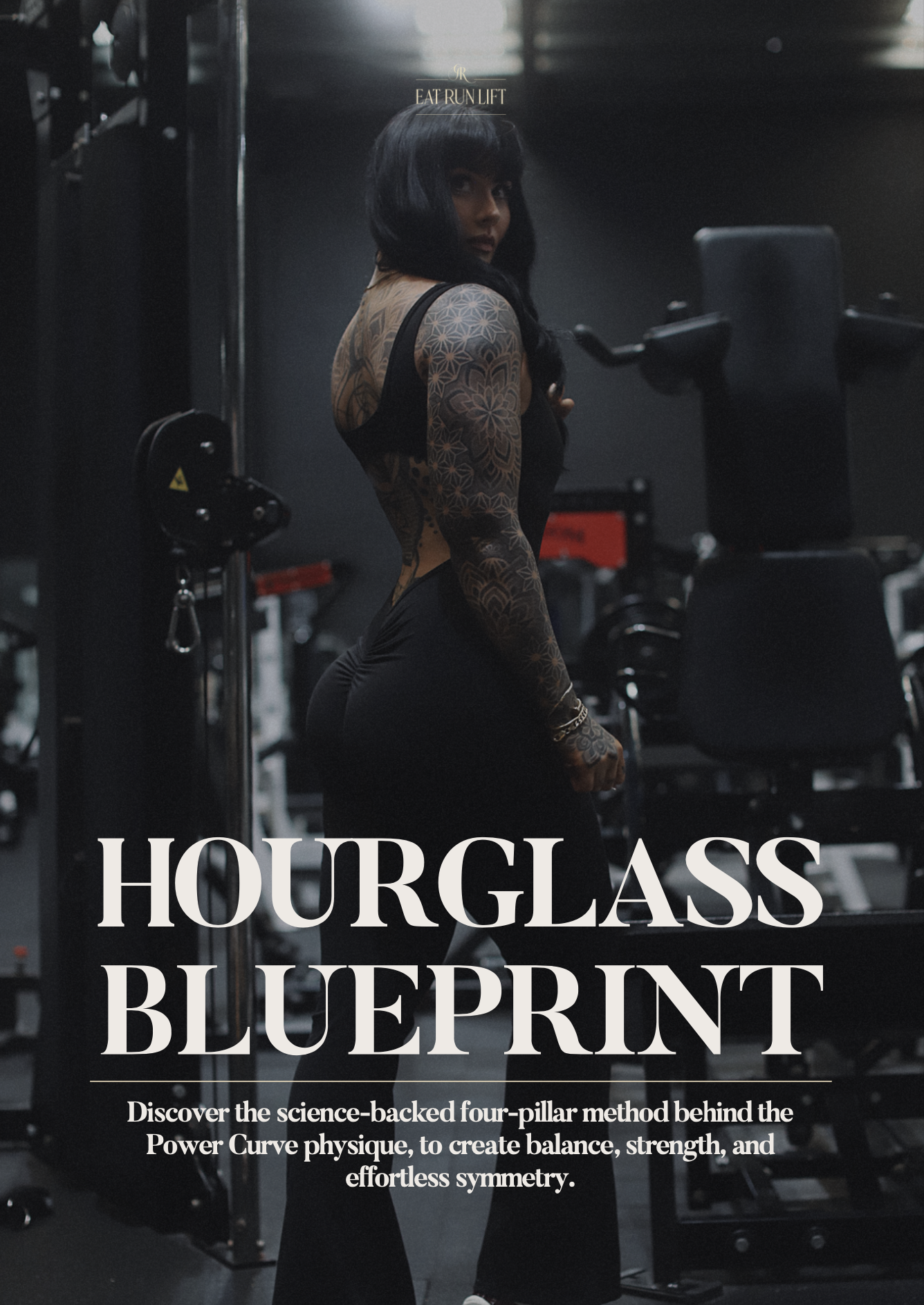
Want some guidance on how I’d structure this?
Download my free Hourglass Blueprint here:
Recovery is not what you do ‘if you feel like it’, it needs to be part of your active lifestyle
Training is the signal. Recovery is the response.
From a biological standpoint, muscle growth, connective tissue repair, glycogen replenishment, and nervous system recalibration allllllll occur during recovery periods, not during the workout itself.
Chronic under-recovery reduces growth hormone output, impairs thyroid signalling, and keeps cortisol chronically elevated, a combination that promotes fluid retention, fat storage, and fatigue (ever trained really hard for a few weeks/months only to feel like you look more puffy? yeah, here’s that)
Sleep is particularly influential.
Research consistently shows that inadequate sleep can reduce training adaptations by up to 30 percent, even when training volume remains high.
This means two women performing identical workouts can experience completely different results based purely on sleep and recovery quality.
For busy women, recovery needs to be scheduled deliberately, not treated as a reward you earn once everything else is done.
This includes rest days, deload weeks, low-intensity movement, nervous system down-regulation, and consistent sleep timing.
When recovery is treated as a non-negotiable pillar rather than an afterthought, training stops feeling like a drain and starts producing visible change.
If you’re reading this thinking, “this makes sense, but I don’t want to design all of this myself”, that’s exactly why I built The Power Curve Method.
The next training block starts next week (!!) and it’s designed for women who want to build an hourglass shape with clarity and structure, without living in the gym or constantly second-guessing what they should be doing.
Inside Power Curve, you’re not just getting workouts. You’re stepping into a system where:
Training is already structured around 3 core days per week, with an optional 4th if and only if your life supports it
Every session is built specifically for hourglass results, glutes, hamstrings, upper back, shoulders, and deep core, so your effort actually changes your shape
Recovery is programmed in, not left up to guesswork, so you’re not stuck in that exhausted-but-still-pushing loop. I’ve also included a specially-designed recovery calculator to help you take into account total lifestyle load, including stress, sleep, neurodivergence, illness etc, so you always know your next move.
Nutrition becomes simpler, with meal planning tools, a huge recipe library, and guidance that reduce stress around what to eat, rather than creating more rules to follow
Most importantly, you don’t have to hold the entire plan in your head!!!
You open my app, you see exactly what to train, how to train it, and never wonder if you’re doing “enough” to get to your goals.
If you’re ready to stop guessing your way along and start following a structure that actually fits your life, the next Power Curve block begins February 16!
You can learn more or join here:
https://thepowercurvemethod.com
Nutrition has to be prioritised, not squeezed in
Another major limitation in overstuffed training weeks is nutrition neglect. Not because women don’t care about food quality, BUT because time scarcity makes regular fuelling or access to fresh meals difficult.
Consistent under-fuelling is interpreted by the body as environmental threat.
Energy availability drops, reproductive and thyroid hormones are downregulated, and the body becomes increasingly efficient at conserving fuel. This is the opposite of what you want when trying to build muscle or change body composition.
Even modest improvements in protein intake, carbohydrate timing, and fibre consistency can dramatically improve training output and recovery capacity.
When training volume is appropriate, nutrition becomes easier to support. Fewer sessions performed with intention outperform frequent sessions performed in a depleted state.
It also means your appetite will be more regulated and you won’t be reaching for the sweet treats after dinner!
The final piece most women overlook is nervous system load.
Mental stress, decision fatigue, and constant time pressure all count as physiological stressors. Training layered on top of chronic life stress without adjustment can push the body into a perpetual state of threat.
Well-structured training reduces cognitive load. You know when you’re training, when you’re recovering, and when you’re eating. This predictability allows the nervous system to relax, which improves hormonal signalling, digestion, and sleep quality.
In practice, women who train fewer days with clearer structure and less mental pressure often experience reduced bloating, improved waist definition, better energy, and greater long-term adherence. These are not just cosmetic side effects, they are ACTUAL signs that the body feels safe enough to change.
If you want a framework that shows you how to structure your week around real life, recovery, and shape-specific training without burning out, get a preview break down inside the Hourglass Blueprint.
Hey there, I’m Rachel!
NUTRITIONIST, PERSONAL TRAINER, WELLNESS COACH
If you’re ready to ditch the all-or-nothing mindset and build a strong, confident body—you're in the right place.
✨ Start with my free 5-day Mini Mindset Reset to design a healthy lifestyle that actually fits your life.
🍑 Or join The Power Curve Method, my signature hourglass training program built to shape your glutes, waist, and mindset from the inside out.
While we make every effort to make sure the information in this website is accurate and informative, the information does not take the place of medical advice.